O |
n Saturday, when I went to M's friend's house for dinner, we talked about riding the train home from work. One person said that he noticed that very few passengers do what the Japanese do--read a book or listen to music. I don't really agree. I have seen my share of those who read novels, work on their laptops or listen to their iPods, although many also seem to be content to just stare out the window and be involved in their own thoughts. But I didn't say anything because I didn't really want to get into a discussion about something as inane as Metro passenger behavior. However, there is one thing that I have rarely seen an American commuter do that all Japanese commuter's will do more than just occasionally: Sleep.
I don't make it a habit to "check out" the other passengers--well, not unless they are... y'know, exceptionally good looking?--but there are very few who fall asleep. But this is a habit that I have adopted whole-heartedly, being the good student of Japanese culture that I am. And I'm not just talking about being drunk and falling asleep, although I have done that, too, on more than a few occasions. Indeed, once M and I were fast asleep in the train--after having imbibed on 5 or 6 beers at the Red Lion next to campus--when we were awakened by a loud clap of the hand right in front of our faces. We snapped our heads up only to see this huge mug of a Metro police officer staring at us. My first thought was, Woah, what's up dude? Do we look like terrorists to be accorded such a rude awakening? But he just said:
"Vienna, last station."
Oh, thanks. And we sheepishly got off the train. I guess we were pretty much wasted by the beer, but still I was surprised that M had not awakened on her own accord. You see, the Japanese have this uncanny ability to wake up at their own station. I'm pretty sure it's not a genetic thing for I was not able to develop this ability fully; but when I lived in Japan, I was slowly getting the knack of waking up right when I reached my station in Tama. I've never been able to figure out why, but it seems that the body develops a sense of "train-ride time". That is, the body--or subconscious mind--knows how long you been on the train and you wake up when you've been on it for X minutes. Of course, this is my unproven and unscientific theory which, of course, is another way of saying it's bullshit. But I have not other way of explaining that sense of "knowing" when to wake up.
 Naturally, this sense can be dulled by extraneous factors, the most obvious being alcohol. Many Japanese share the same story of sleeping on the train after a night of drinking, then waking up just as the door is closing at their station, or like me ending up at the last station on the line--I've walked home from Tama Center to Nagayama twice, having missed my station on the last train of the night. So, I guess it wasn't so odd to be awakened at Vienna by the Metro cop. Thankfully, I live off of Vienna so I didn't have to walk to another station.
Interestingly, the dulling of these senses seems to have conversely triggered the genius of some. Look at the photo. It is a woman wearing a brand new invention--the "Wake Me Up" hat. Besides preventing her from resting her head on the shoulders of a neighboring passenger--and this DOES happen in Japan--the hat has a sign on it. It's hard to read from our camera angle except for the bottom, which happens to read, Nishi-Ogikubo. Since this is the name of a train station on the Chuo-line, I can easily guess the message that precedes it: "If I'm sleeping when the train reaches the station named below--begging your indulgence--please wake me up."
Only in Japan...


 When there was a call for masterless samurai--at this time, they used the term roshi instead of ronin--to go to Kyoto help protect the Shogun during his say there, they gladly went with their peer and dojo mates. Upon arriving in Kyoto, there was a call to return to Edo by the organizers Sasaki and Kiyokawa. The story is that this was simply a ruse by Kiyokawa to gather samurai who he would eventually turn against the Bakufu. Kondo and Hijikata for whatever reason remained--according to the drama, they couldn't accept returning to Edo without having done anything to protect the Shogun. They stayed at an inn in an area of Kyoto called Mibu and were hence known as the Mibu-roshi. From there, they worked to recruit more members and appealed to Lord Matsudaira--leader of the Aizu clan of Fukushima, official protector of the Shogun's interests in Kyoto--to allow them to participate in their official endeavors of policing Kyoto. They actively worked to police the capital, and their efforts were recognized by Matsudaira, who designated them the Shinsegumi--Company of the Newly Selected. This name reflected what Kondo had always aimed for: a new band of brothers from all walks of life, chosen by merit, not lineage. After the Ikedaya Incident where the Shinsengumi squashed a plot by the anti-Bakufu members from the Choshu clan, Matsudaira named Kondo and the Shinsengumi hatamoto--direct vassals to the Bakufu. Unfortunately for the Shinsengumi, their idealistic image of the samurai led to an undying loyalty to the Bakufu and the inability to recognize the sea change occurring in Japan.

 That would give us 2 three-day weekends in a row.
  I have not seen any of the older, silent samurai motion pictures (katsudo shahin), although maybe I should as they are not that old. Bloody Town directed by Yashiro Takeshi was relieased in 1938, eleven years after the first American talkie The Jazz Singer (1927). While there is no audio, the action sequences are purportedly superb. If nothing else, I am tempted to see Makino Shozu's Chushingura (The 47 Ronin, 1910, 1913), the oldest extant version of the 47 loyal samurai, but to get a good grasp of the symbol of the samurai in J films, one only has to see Mizoguchi Kenji's version, Genroku chushingura (1941).
 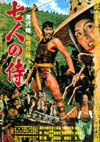 The Seven Samurai
 Talking to him brought back many old memories. KM used to live down the block and we hung out together, but when we first met outside of school, he still lived in downtown LA on Main Street. Yes, back then there were still families living in hotel suites with long term leases, like an apartment, but it was rather unusual for a guy like me from the suburbs. On that one occasion when I went to his home, it was the day his father took us out to the LA Police Academy in Elysian Park. There, we mostly hung out at the shooting range collecting shells. I was about nine or ten years old and had never seen a gun or bullet before, so the thought that we could just pick up spent shells and take them excited me. Juding by the color I presuemd they were made of copper. I put a bunch into a clear plastic bag and took them home. My mother had a fit. She didn't want me having bullet shells in the house--as if they were going to go off. I tried to reason with her, but she would have none of it. She said to throw them away in the trash can out back.