Thursday, August 07, 2003

A Few Words of Response to Yesterday's Entry

Did your mother feel conflicted about living in the US after the war? 
Not that I could tell, but she was pretty good at concealing her feelings. She came to the U.S. of her own free will to get married. And while she never expressed it directly, she instilled in me a sense that we are all individuals, our acts are individual acts of free will (under most circumsatnces) and as individuals we must accept responsibility for them. So I figure she felt the same way. That is, she wasn't going to hold the American people accountable for decisions made and acts taken by a few. Indeed, this general outlook may explain why she preferred the U.S. to Japan, a country where individual acts can be attributed to a group, and responsibillity must be accepted by the group. Maybe, this explains why I didn't fall into the trap of thinking I had to go to school within a specific time frame or follow the typical JA standards of behavior... maybe...


Did she ever naturalize?
Yes, she did become a US citizen. She told me that she wanted to be a citizen of the country where her children were born. Moms... don't you just love 'em?


Have you ever seen "Grave of the Fireflies"?
Yes, I have. The life of children under horrific conditions such as war, struggling to survive, and ultimately succumbing to cirumstances they had nothing to do with, was far too "realistic" for an anime. As Piratechan might agree, it's not the "realism" of the illustrations, but the "reality" in the story, content, emotion, that is at the heart of any good film, animated or not. But seeing the movie once was enough. I'm afraid that if I see it again, I'll breakdown all over again... I get choked up just thinking about it here... (yeah, yeah, just an old geezer...)


I've always wondered what it would've been like to have lived through an ordeal like what your mother went through.
I have too, and I can't even begin to imagine what it was like. I've lived through two major earthquakes--Sylmar ('73) and San Fransisco ('89)--but suffered little damage. I've been in a couple of auto accidents, but survived both. Learning and trying to comprehend the extreme hardships experienced by my mom and dad (he "voluntarily" relocated during WWII) have made me appreciate the life I have lived--indeed, all my gripes and complaints about life seem petty by comparison... But, y'know, my parents have NEVER, EVER told me to stop complaining, that their life was harder, or any other of a thousand ways to say "well, when I was your age"... I miss my mom...


Lecture of the day: Younger readers--yes, you--make sure you always appreciate your parents. They may not always seem like it now, but they will likely prove the be the best things in your life.

Wednesday, August 06, 2003

Pause to Relfect

I have been writing about myself so earnestly--me, me, me, me, me--that I had forgotten what day it is today: August 6, the day the US dropped the atomic bomb on Hiroshima. Props to Taknunishi79 for reminding me of this important day.


A-Bomb, Hiroshima, and Mom
Today is the 48th anniversary of the dropping of the atomic bomb on Hiroshima. Every August, this becomes an intense issue for many anti-nuclear groups and opponents. For me, it is just as intense, but for more personal reasons.


My mother is an A-bomb victim--hibakusha in Japanese. That makes me a second generation victim, and the research on how radiation effects second generations is still inconclusive--although a friend has told me that if I'm any indication, the research should lead to illnesses like Peter Pan syndrome. But this is not about me....


My mother--photographed in the early '50s next to Honkawa, a river in Hiroshima (I think the Atomic Dome is visible in the background)--rarely talked about her experience. I had asked her a couple of times, but she would only tell me it was terrible and offered virtually no detail. On my first trip to Japan, I visited my relatives in Hiroshima with her and learned that most victims indeed did not talk about the event... until they were talking to someone who went through the same experience. In my great-aunt's house just northwest of ground zero--the Atomic Dome--she talked very animately with her cousin's husband about their experience. I was mesmerized, and now kick myself in the butt for being so selfish, for not recording their conversation on tape or on paper to share with others. All I can offer you today is my memory--as suspect as it is.


I had interviewed my mother a few times and actually put some of it on audio tape before she passed on last year, but I have yet to transcribe them as it is still too painful even to listen to them. So I will not write about her fateful day--I will do that on some future date relying on her memories. Instead I will jot down some of the insights I have gained through her over the years...


Burns: They were shiny oval areas on her legs. They differed in size, from 4 inches to 6 inches in length. Each had what looked like veins in a leaf: a center vertical vein with several branches sprawling outward from there. I always stared at them and at times tried to run my fingers over them, but every time I tried, she would slap my hand away. These are the remnants of her burns she suffered from the atomic blast. Her burns were severe and promoted keloids--an excessive production of scar tissue. She later explained to me that these keloids would form, then become dead skin that turned black and then peeled away. After a time, as her wounds healed, they stopped forming, but they left these shiny reminders of August 6. Whenever she slapped my hand away, she would just say, "Stop it." But I wonder if it was because it hurt or because she didn't need anyone else to bring attention to her experience. These weren't her only reminders.


Physical Scars: She had an ear--the left one--that looked like a boxer's cauliflower ear. Whenever my siblings and I were horsing around and we accidentally brushed against this ear, she would freeze in pain. Causing the pain were minute shards of glass. They had been embedded inside this cauliflower ear when the windows of her office imploded from the blast. After the blast, she went to a hospital to have them removed, but she was sent away, told that she should count herself among the lucky; patients that demanded "real" care needed their attention first and foremost. My mother just let the wound heal-over as is. Amazingly, she still maintained some--albeit diminished--hearing in this ear.


Psychological scars: Whenever we went outside, particularly when she was driving, my mother wore excessively dark sunglasses. I thought she was just trying to be California cool, but I found out later that there was a reason related to Hiroshima. When she was speaking with her cousin's husband, he mentioned that even today he flinches when he sees a sudden flash of light--a reminder of the flash on August 6. My mother nodded in agreement. She went on to describe to him how sunny southern California is and that when she was driving, a glint of sunlight reflecting off a car's chrome bumper always made her catch her breath...


I was reluctant to reveal these things about my mother--she consistently avoided talk about her scars and she always tried to hide them. But towards the end of her life, she suggested that perhaps her experience might prove to be noteworthy to some. I hope that some might serve as a reminder of the horrors of war and the effects of a nuclear blast--as we all know, there are some who unfortunately still need it...

Tuesday, August 05, 2003

Not Living Up to Expectations

This is a prologue to the fifth installment, the continuation of subjective memories of not living up to expectations.

After my return from Japan, I had much to think about. How do I address this new realization that I am NOT JAPANESE. Through the crystal clear prism of hindsight, it was foolish of me to even think I was Japanese: I wasn't born there, I had never lived there, I didn't know the language as well as I thought I did, and my understanding of Japanese culture was anachronistic, a vestige of the Meiji/Taisho (late 19th/early 20th cen.) period. But in the winter and early spring of 1975, I did not have the benefit of this hindsight, so I did what any confused 19 year-old would do: A little of this, a little of that, and a lot of bumming around...

As I sit here and try to recall the years between 1975 and 1979, I realize that they are not very clear in my mind. Many memories and the order in which they occurred before this five year period are stored in my mind in a clear and coherent fashion. My first major scolding: When I was 4, I managed to open a can of paint and proceeded to redo my red fire engine and my sisters bicycle; I was sent to my room where I think I threw everything I could get my hands on at the door in frustration... My first taste of scotch: 5 years old in our old house in East LA, given to me by my Uncle Frank, "Try it. It's adult apple juice"... The first time I realized that I might truly be different: The father of a friend down the block, Ricky Santa Maria (real name), used to call me tomodach, and I thought he was cursing me... Other times when I knew I was truly different: Getting beat up by local toughs when my friends and I at 12 rode our bikes past Belvedere Park on our way to the Library because were japs and gooks and chinks (they couldn't make up their minds)... The first time I held hands: At Knott's Berry Farms on a field trip in 8th grade with a girl who today would probably even deny she knows me... My first cigarette: In the back yard, behind the garage at 14, with my mom's lighter and Kent's... My first real part-time job: At the sweetshop at 17, going downstairs with a girl two years my senior, who took me downstairs to get me an apron and had me carry up a case of boxes--it was my first serious crush... I remember all these events and the sequencing with a high degree of clarity...


Yet, the five-year period from the age 19 to 24 are blurred, jumbled together. I recall isolated incidents, miscellaneous dates, different jobs intertwined with each other. Perhaps all these are just proof of how really confused--if not just simply screwed up--I was. As I continue to log portions of my life on this public forum, it occurs to me that I am not here to provide fiction. Many write about current relationships (I argued with my boyfriend, I hate my boss, I love my dog) or about current incidents (I went to school, I saw a movie) or about dreams and goals (I wanna go to Japan, I want to meet the perfect guy or girl). All are personal and interesting, sating our voyeuristic tendencies. Me? I am writing something that is just as personal--perhaps even more so, since it is something that has been a part of my life for that last 40+ years: my memories. It is something that I cherish and relive in my mind--good and bad--from time to time when I can't go to sleep, or when I'm sitting in the train exhausted, or when I'm feeling frustrated at work, or when I'm just feeling sad with a glass of scotch in my hand... So it really bothers me that I can't articulate this five year period coherently. I don't want to make anything up, so I've even gone back to look at old records and photos to see if they might jog my memory, but no luck. So I will instead provide a basic timeline and relate isolated incidents that I remember that might prove to be salient to this selected record of my life...


More to come...

Monday, August 04, 2003

Top Ten Japanese Eats--Response:

Amazing... You talk about food and everyone chimes in... which is always a good thing.


To Masumi: The umeboshi at Umehachi is Kishu ume. But its the preparation, man. I swear, everyone who reads me and likes umeboshi has got to try this at least once in their life. It really is good. She also asked if I like tofu, and the answer is an unqualified yes! I eat tofu all the time, and pretty decent tofu is available here, so its nothing that I really crave for when I go to Japan. I eat it cold (yakko), hot (yudofu), fried (age-dashi), and as well as prepared in other dishes. I make a mean butadofu (pork and tofu), but my specialty is tofu pomodoro: tofu cooked on a grittle then covered in sauce of fresh tomato, mushroom, onions and parsley, topped with fresh basil when served. Mmmmm. It's kinda like Giappone nuovo. I got the recipe from Taiyo Sankan, soccer crazy pub in Hachioji. I told the master that I was returning to the US and would never have the chance to eat his tofu again, and so he gave me the recipe. What a guy!


Some may have wondered why sushi was not on the list. That's easy. First, sushi itself is a broad category, I love madai, but do not eat uni (sea urchin) and hate hoya (sea pineapple--yuck). I also don't particularly crave shell fish. Clams? Better with linguine. Oysters? Fried is best. Crab? I love crab cakes. Ama-ebi? Shrimp is for tempura... Just give me the raw fish. Takunishi79 commented that he ate sanma sashimi yesterday! Your profile says you live in Georgia. Where did you eat the sanma sashimi? In your dreams? If your for real, you should share the love, dude...


And as tak79 and those_days pointed out, Mos Burger is overpriced. And many may not prefer its taste, but I think it's just different enough to make it worth it. But Kai, burger to burger, In'NOut wins hands down (but it doesn't beat Astro Burger). Like I said, I'm probably just weird... Besides, at #1 I figure it was good for a laugh!


Clarification: Yes, gurlekka, I have kids, and yes, dorkus_maximus, they are about your age... BUT, they are about your age EVERY year. They never seem to grow up because when I wrote, "my kids", I meant, "my students" and evey year, they're around 20-22 years old. Year in and year out, it seems like I'm the only one getting older... By the way, I do have a daughter (real one, my own) who is living with her mother in Japan. She's 16. I have one stepson here in DC and two more in Japan, all three from my current marriage: 21-25 in age. AND--are you guys sitting down?--I also have two grandkids in Japan with another coming soon. Yes, Onigiriman is a じっちゃん (grandpa)... although they call me 運転のオジサン (driver), since they only know me as the guy who picks 'em up at the airport...


Pretty busy today: full schedule--son's interview, departmental meeting, class, grading midterms--ugh! But I'll return to the story as soon as possible. I gotta do some research!

Sunday, August 03, 2003

More Weekend Fluff

Top Ten Eats...
I Love food. Ask my kids. I can't stop talking about it sometimes. I was going to list my ten favorite foods, but realized that the category was to broad. So I paired it down to foods I like to eat when I'm in Japan. So this is my Top Ten...


10. Umeboshi (salted plum) is generally okay--inside onigiri, with chazuke. But there is one umeboshi that is good enough to make me look forward to it when i go to Japan: Umehachi. This company has two branches in Tokyo that I know of, Kunitachi and Hachioji. YOu can also order online. the one to eat is called Godai Ume. It's sweet and more like okashi (confection) rather than a salted condiment. But its pricey.
9. Kamasu/sanma: Kamasu is translated as "barracuda" in the dictionary, but I'm not sure that's right. It's much small than what we might imagine as barracuda. Anyway, salted and hiraki (opened as if butterflied) is a great fish to broil. Its great with rice or sake. Kamasu is hard to find in the US, unless you're on the west coast or New York. Sanam is equallyu delectable, particularly in September and October shen you can eat really fresh sanma. I'm not sure why this particualr season, but when you broil it, you can eat the innards as well and it almost has a sweet taste to it. this is the only season you can eat it as sashimi as well. I used to make a day trip to Shiogama in Miyagi Prefecture every year just to eat it. It's THAT good. If you go, and they serve it with a kind of miso, ask for it on the side. Note that the sanma they catch in Chiba (I think in Choshi) is not the same as the sanma they catch up north in Miyagi. There is a noticeable difference in taste.
8. Tonkatsu is a favorite of many, and there are many good places. I just make sure that I go to a place that is not too cheap and has good customer turn over. I've been to places that are cheap when I was a student and paid the pirce later. I learned the hard way that there is a chance of the oil being old, and that'll make you sick if you're sensitive. There is a good place in Tama City, Tokyo, near Nagayama Station (Keio Line) called Ume~ya. I know, the name sounds corny, but the preparation is solid, the tonkatsu sauce is a family secret--so they say--and you get to grind your own sesame seeds. Of course the shredded cabbage is all-you-can-eat.
7. Tempura is truly one of the finest in Japanese cuisine, although it's allegedly Portuguese in origin. Shrimp and vegetable tempura is certainly good, but when available, I eat anago (sea eel) tempura. It comes out so soft and fluffy! Oh gawd, I'm drooling right now even as I recall its succulent texture and taste..... Aaaargh! Tabetai!
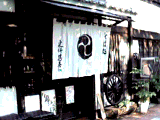
6. Soba can be found anywhere in Japan, and there are many good places. But if I had to go to only one, it would Sarashina Jingoro in Kunitachi, Tokyo. They use Shinshu soba and it is always al dente. The best dish is the Tanuki soba. This is different from most--usually Tanuki soba is just the deep-fried batter used for tempura. Here the topping a Kakiage--a mix of vegetables and seafood deep fried in batter--and it comes out so hot, I have to wait a few minutes for it to cool down. So I usually have to dig down beneath it to start to eat the soba first--don't want to let it get soggy. Note: This shop is south of the station. Do not go to the Sarashina north of Kunitachi station.
5. Okonomiyaki, for those who don't know, a dish with shredded cabbage mixed with a flour batter and cooked on a grittle. It also contains other vegetables and meats. There are two competing styles of okonimiyaki, regular, which is associated with Kansai, and Hiroshima-style--I once referred to it as Kansai-style and was scolded by a Kansai person, "Okomiyaki was created in Kansai, so that name itself already implies Kansai. Kansai-style would be repetitious." Excuuuuse me. I digress... MY peronsal choice, however, is Hiroshima-style. The "original" okonomiyaki mixes the batter with the other ingredients. In Hiroshima style the batter is thinly spread on the grittle like a crepe and the cabbage, bean sporuts, green onions, pork slice, octopus and other things are mounted on top, then flipped over. There is less batter and hence less filling. While the best place to eat it is in Hiroshima (duh!), you can get a good one in Tokyo. There are a number at the Shimo-Kitazawa station of the Inokashira Line, but the closest to the real deal is Otafuku. Leave the exit directly from the Inokashira platform and turn right. Fortunately, I can make this at home, which I do for my kids who study Classicla Japanese... they deserve a break...
4. Tora Mangen is a Chinese restaurant and perhaps doesn't belong on this list, but it is the best Chinese food for any price (except Hong Kong Flower Garden--the original store--in Milbrae, CA). Tora Mangen is so good and became so popular that there is a chain of restaurants with similar but different names around the San Tama region (Hachioji, Tama, Machida area). By Japanese standards, it is inexpensive and the food is first rate... The Yakisoba is to die for, and the Nira Manju is scrumptuous. <sigh!> The main store is on a small street two blocks west of Hachioji Station on the Keio Line.
3. Ramen is ramen? Well kinda. I konw people who swear by the instant Chikin Ramen, but I suspect its mostly out of nostalgia. The best ramen I've ever eaten was at a place called Bannai, in Kitakata City, in Fukushima. It is a journey to get there, but if you ever find yourself near Aizu Wakamatsu, then its not too far. My dad is from this small city, which is why I know about it, so you may say, "Big deal, every town has their favorite ramen shop." But this is truly exceptional ramen. To give you an idea as to how good it is, they have tour buses from Tokyo lined up outside from 10 in the morning. Honest. the best, naturally, is shoyu ramen. I rarely eat any other style anyway. I stick to the basics. Of course, when I feel the carnivore, I eat the Chashu ramen, and the negi ramen is also good. Bannai's popularity has grown and they now have shops in other cities, including a number in Tokyo, but they are not as good. Apparently, they get their soups stock concentrated from the original store, and they dilute it with local water, so the difference must be in the water. Kitakata makes good sake as well, so you know the water is good.
2. Madai or tile fish? Whatever, its the best fish on the planet, particularly, sashimi. It is best in the cold months when they are a bit more fatty. I could eat it forever. If there is leftover--a very rare case--I pour shoyu over it and keep in the fridge until the next morning and eat it for breakfast: tai chazuke (tea over white rice). I'm usually in a good mood all day. the best place to get tai at a reasonble price is in the asement of Keio Dept. Store in Shinjuku AFTER 6pm. Everything goes on sale. But beware of the Obatarians (pushy middle-aged ladies), they are very aggressive. But I'm an ojitarian (male counterpart), so I just kinda push back... haha...
1. Mos Burger. I know you are probably laughing now, but this is the one thing--well, Tora Mangen, too--on this list that is impossible to get in the US. The other things, you can get in some shpae or form in varying degrees of quality, but a Mos Burger cannot be had. The filler in the burger... mmmm, how Japanese. The thick slice of tomato... they're secret sauce... This is the first thing I eat when I get to Japan, every trip. Okay, so I'm wierd, so sue me!